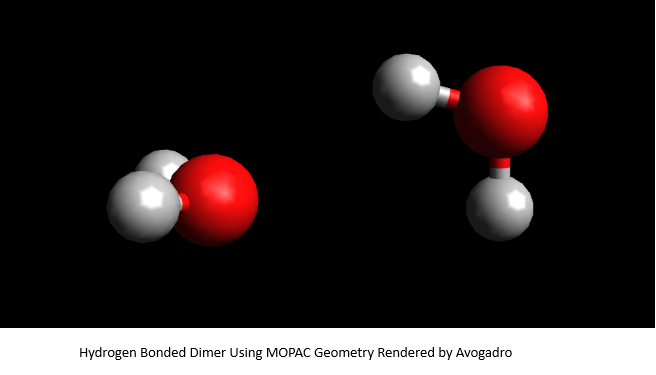
The intent of this blog is to get technical reviews of papers on the role of phonons in the properties of water. This is a purposeful sidestep of the conventional publication process, hopefully to gain a broader cross section of thoughts on the topic.
It may be useful to describe what a phonon is. Molecular excited state energy can be exchanged between similar molecules. If the exchanging molecules are coupled, say, by electrostatic interaction, the energy can be distributed across them. In a large group of molecules there can be many such interactions. We first describe the energy of each atom in the group as a function of its coordinates. It is then possible to calculate the matrix of second order partial derivatives of energy with respect to the coordinates. The eigen functions of this matrix are the normal vibration modes of the cluster and the eigen values give the frequency. Each mode is a phonon. It is a particular, possibly complicated, mechanical vibration. Modes can be created or destroyed by changes in the geometry of the molecules.
Water phonons identified by Elton are based on hydrogen bonds. These phonons describe about half of the heat capacity of water. Much of the remaining half is kinetic and rotational. Thus, energy in water has two varieties which have different propagation properties and interactions with the world outside. Most people are familiar with the superheating of water by microwaves which excite vibration states and create phonons without immediate transfer to the usual thermal states.
Blog entry Phonons and Evaporation shows that a MOPAC-THERMO calculation on a blob of randomly positioned water molecules can produce phonon modes that match the modes found by Elton. These modes also match radiation modes found in the study of water condensation, called phase change radiation. An energy threshold derived from surface tension measurements for release of a molecule to the gas phase by propagating phonon energy reproduces the equilibrium vapor pressure effusion with no additional empirical parameters. That is, evaporation from the surface of bulk water occurs when phonons arriving at the surface release single bonded molecules to the gas phase. A similar event likely occurs with the lower energy diffusive kinetic energy. The primary experimental variables for the process are the temperature at the surface and the geometry of the condensed phase. Oversimplified, the phonon model says evaporation is controlled by a reaction at the surface to which phonons provide energy while classical theories say that evaporation is controlled by humidity in the gas phase. In the latter case increasing air temperature could increase evaporation. Under phonon theory only increasing sea surface temperature will increase evaporation, and coupling of gas phase radiation into the reaction is small.
Blog entry Column Water and Sea Surface Temperature shows that sea surface temperature is the primary factor in column water production above the oceans. Evaporation accounts for more than a third of the solar energy reaching the surface.
 Water Phonons